描述
Scope of Application
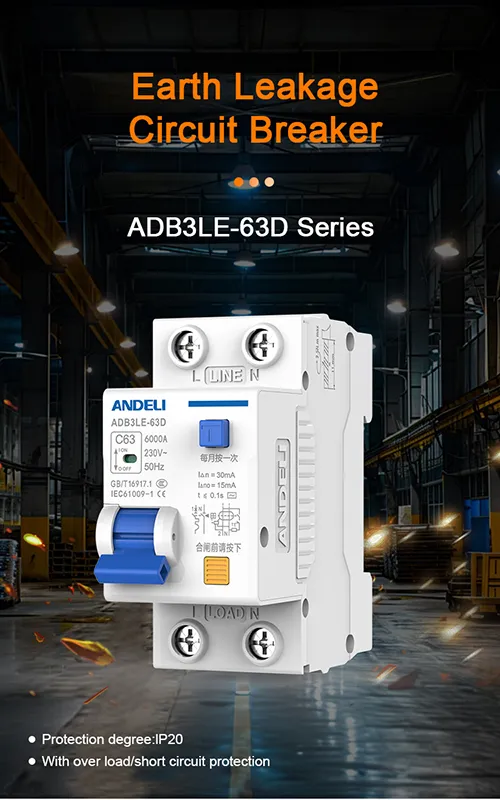
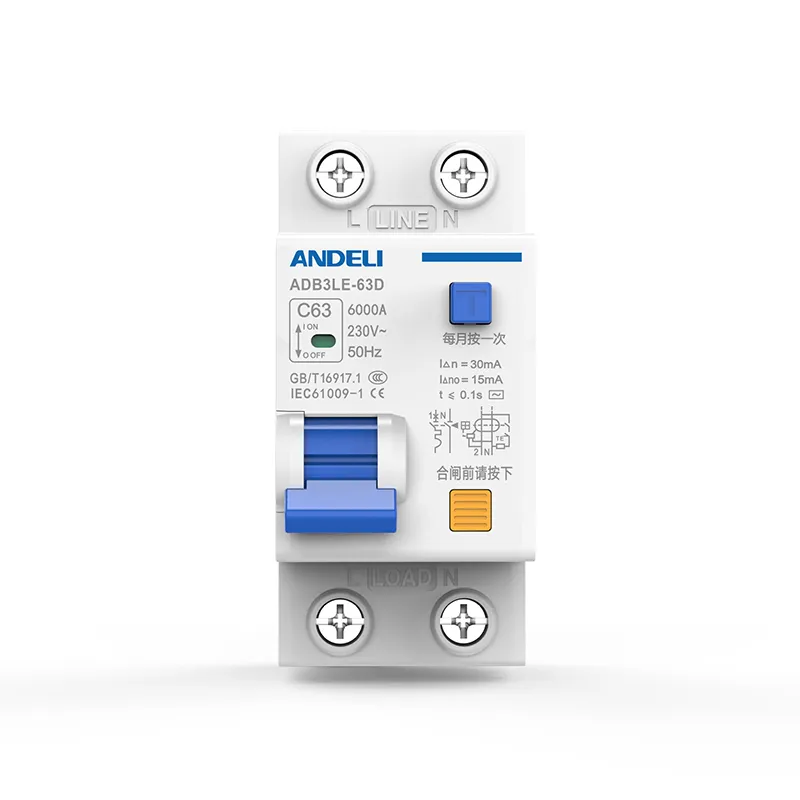
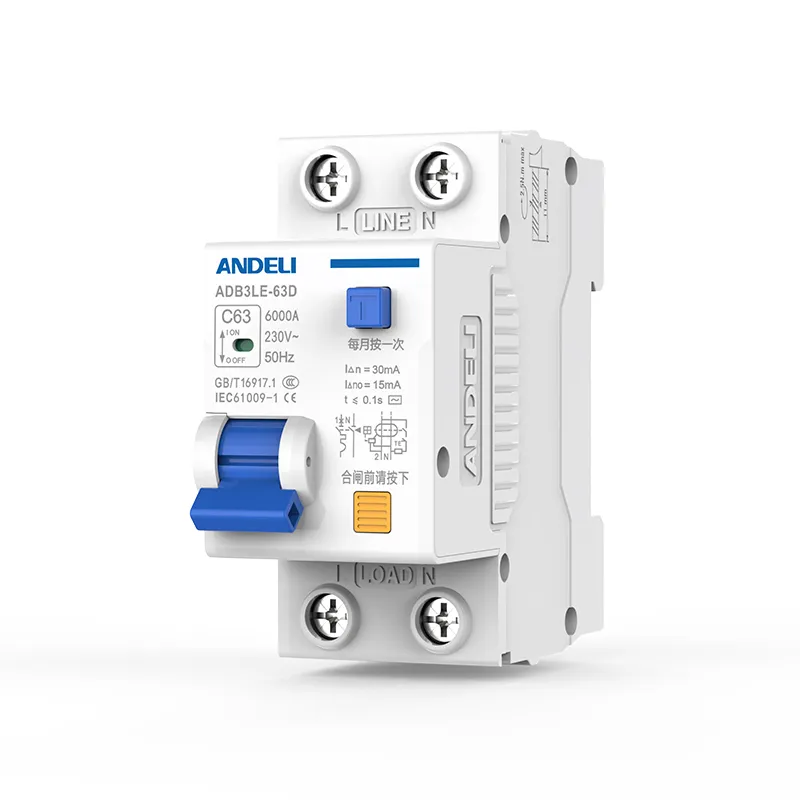
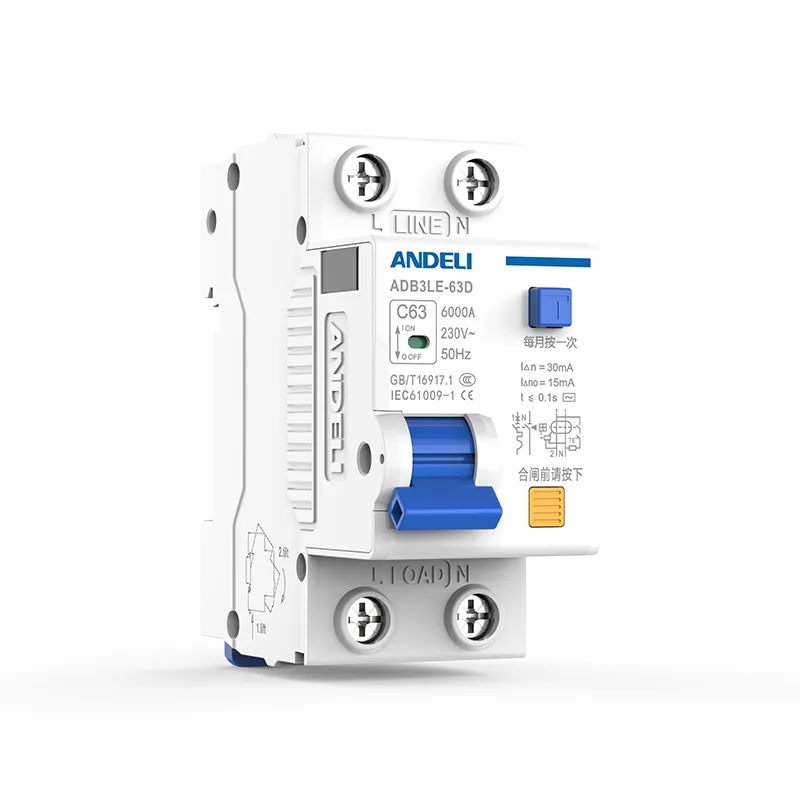
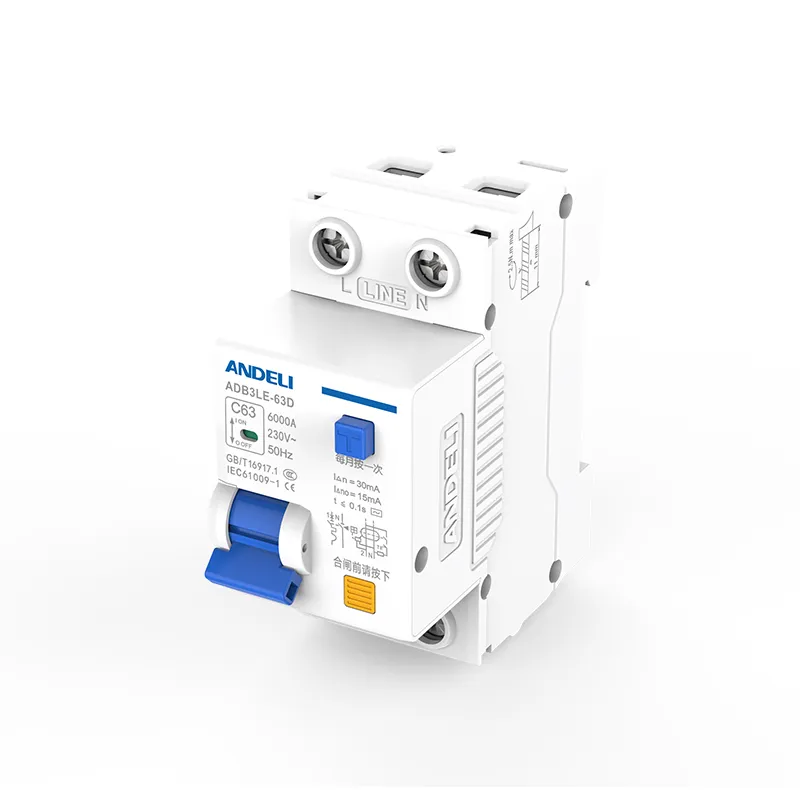
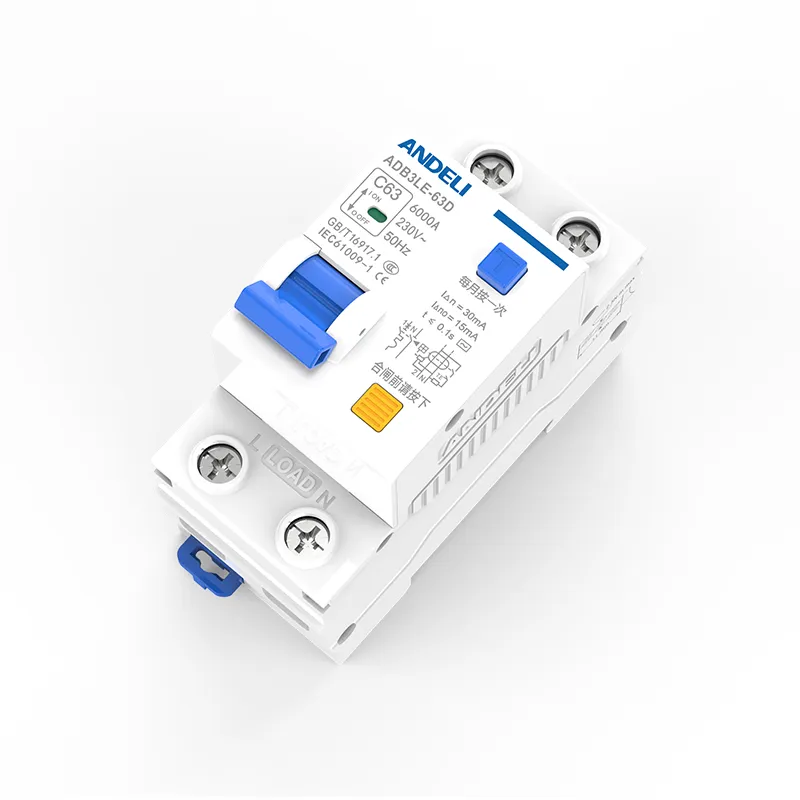
The ADB3LE-63D/ADB3LE-63S series residual current circuit breakers (hereinafter referred to as residual current circuit breakers) are mainly used for personal electric shock protection in protection circuits with AC 50Hz, rated voltage 230V, and rated current up to 63A. They also have overload and short circuit protection functions, and can frequently turn on and off electrical devices and lighting lines under normal conditions, especially suitable for industrial and commercial lighting distribution systems.This product complies with GB/T16917.1 and IEC61009-1 standards.
Normal working conditions and installation conditions
2.1 Surrounding air temperature: The surrounding air temperature is -5℃~40℃: the average temperature within 24 hours does not exceed 35℃.
2.2 Altitude: The altitude of the installation site shall not exceed 2000m.
2.3 Atmospheric conditions: The relative humidity of the air at the installation site shall not exceed 50% at a maximum temperature of 40℃, and shall not exceed 90% at an average minimum temperature of 20℃ in the wettest month.
2.4 Installation Category: The installation category is Class Ⅰ or Subclass.
2.5 Pollution level: The pollution level is level 2.
2.6 Installation type: Standard guide rail installation is adopted.
2.7 Installation conditions: The external magnetic field of the installation site should not exceed 5 times the geomagnetic field in any direction. The residual current circuit breaker should generally be installed vertically, with the handle facing upwards to connect the power supply. The installation location should have no significant impact or vibration.
2.8 Wiring method: Use screws to tighten the wiring.
Model and meaning
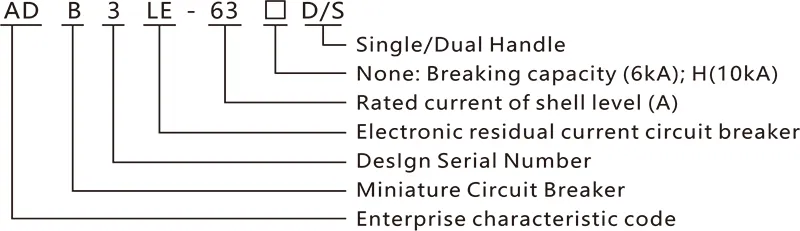
Classification
4.1 According to the rated current, there are nine types: 6A, 10A, 16A, 20A, 25A, 32A, 40A, 50A, and 63A;
4.2 Two pole circuit breaker with one protection (2P);
4.3 The types of instantaneous release devices are: B-type (3In-5In), C-type (5In-10In), and C-type (10In-20In).
Structure and working principle
When the handle of the residual current circuit breaker is turned to the ON position, the mechanical mechanism pushes the contact to make reliable contact with the static contact, connecting the circuit. When an overload fault occurs in the circuit, the overload current causes the thermal bimetallic element to bend and pushes the lock buckle to reset the mechanical locking mechanism. The moving contact quickly separates from the static contact, thus achieving the function of breaking the circuit. When a short circuit fault occurs in the circuit, the short-circuit current causes the instantaneous release device to act, and the iron core push rod pushes the lock buckle to lock the mechanical action and achieve the breaking function. When a leakage or electric shock fault occurs in the circuit, the zero sequence sensor outputs a signal that causes the thyristor to conduct the residual current release iron core, and the push rod pushes the circuit breaker to trip, causing the residual current circuit breaker to cut off the power supply in a short time, thus achieving the leakage protection function.
Structural characteristics
6.1 Small size, compact structure, and better price compared to similar products;
6.2 The shell and some functional components are made of high flame retardant, high temperature resistant, and impact resistant materials;
6.3 Directly install with neutral wire to avoid potential electric shock hazards caused by incorrect neutral wire wiring;
6.4 Adopting the latest circuit design and high-performance electronic components, it has a strong ability to withstand surge currents and overvoltage without causing misoperation. It is installed on rails, which is convenient and time-saving.
Main technical parameters
7.1 Main technical parameters are shown in Table 1;
7.2 The time current action characteristics are shown in Table 2:
7.3 Residual current protection characteristics;
7.3.1 Rated residual operating current I Δn; 30, 50, 75, 100mA;
7.3.2 Rated residual non operating current I Δno: 15,25,40, 50mA
7.3.3 Rated residual current on/off capability IΔm; 2000A,
7.3.4 The breaking time for residual current operation is shown in Table 3;
7.4 Mechanical and electrical lifespan; The residual current circuit breaker can withstand 4000 operating cycles, with an electrical lifespan of 2000 cycles;
7.5 When using a circuit breaker, refer to Table 4 to select the copper wire area,
7.6 Trip characteristic curve is shown in Figure 1.
Table 1
| INM A | Rated currentIn(A) | Rated voltage(V) | Short circuit breaking capability during operation | Overcurrent instantaneous trip type | |
| Ics(A) | Cosφ | ||||
| 63 | 6, 10, 16, 20, 25, 32, 40, 50, 63 | 230 | 6000 | 0.65-0.70 | C |
Table2
| Serial Number | Rated current of release device (Iₙ(A)) | Start State | Experimental current A | Set time | Expected results | Test environment temperature | Notes |
| a | ≤63A | Cold State | 1.13Iₙ | 1 ≤ 1h | Do not release | 30℃-35℃ | |
| b | Hot State | 1.45Iₙ | t < 1h | Release | The current steadily rises to the specified value within 5 seconds | ||
| c | Cold State | 2.55Iₙ | 1s < t < 60s (≤32) | Release | Close the auxiliary switch and turn on the power supply | ||
| 1s < t < 12s (>32) | |||||||
| d | Cold State | 5Iₙ | 1 ≤ 0.1s | Do not release | |||
| e | Cold State | 10Iₙ | 1 < 0.1s | Release |
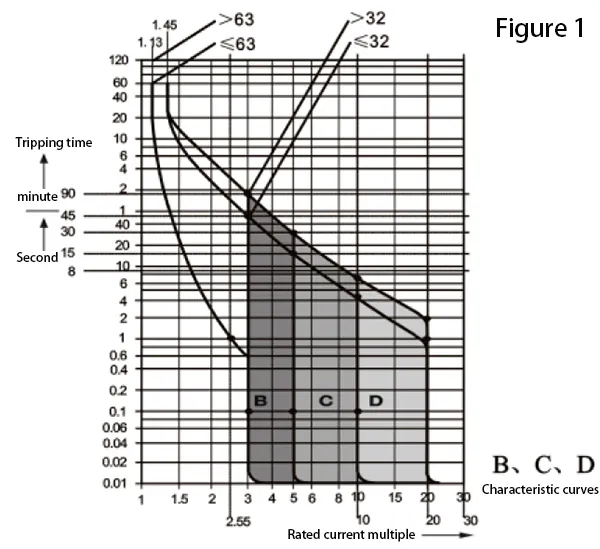
Table3
| Model | In(A) | I□n(A) | The breaking time (s) when the residual current (IΔ is equal to the followialues | |||
| IΔn | 2IΔn | 250mA | ||||
| General Type | 6-63 | 0.03 | 0.1 | 0.05 | 0.04 | Maximum interruption time |
| S Type | 25-63 | >0.03 | 0.5 | 0.2 | 0.15 | Maximum interruption time |
| 0.13 | 0.06 | 0.05 | Minimum non driving time | |||
Table4
| Rated current(A) | In ≤ 6 | 6 < In ≤ 13 | 13 < In ≤ 20 | 20 < In ≤ 25 | 25 < In ≤ 32 | 32 < In ≤ 50 | 50 < In ≤ 63 |
| Wire cross-sectional area (mm²) | 1 | 1.5 | 2.5 | 4 | 6 | 10 | 16 |
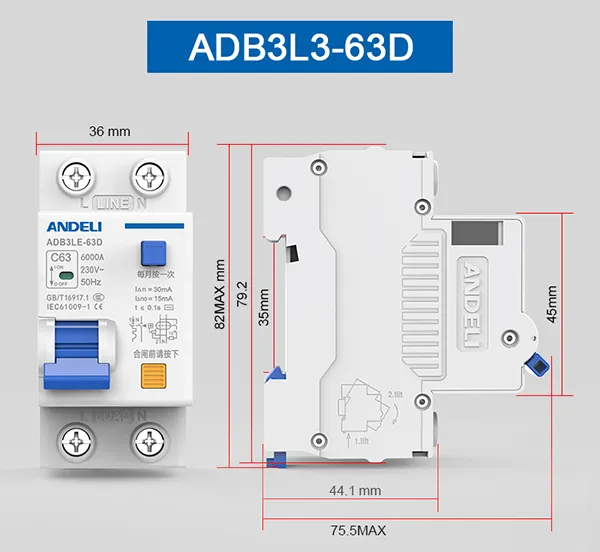
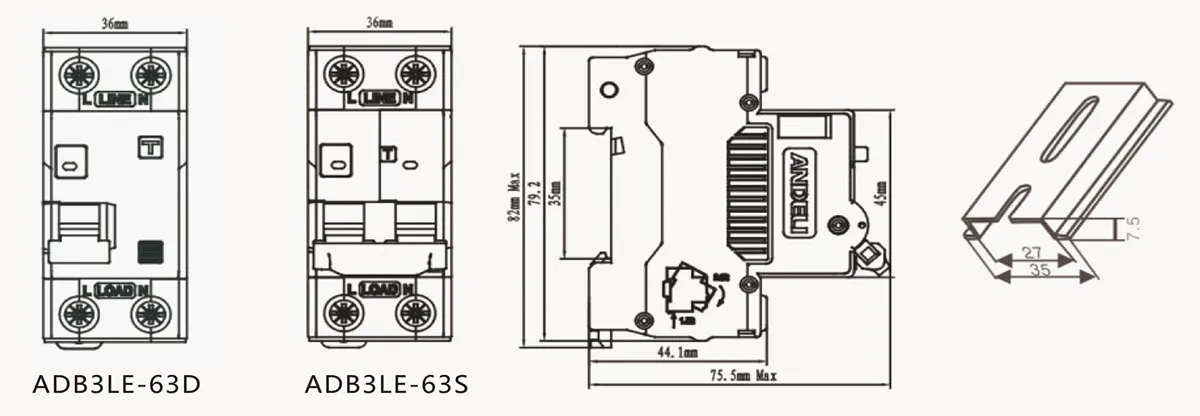
Appearance and installation dimensions
Usage and maintenance
a.To close the residual current circuit breaker, push the handle upwards in the direction of the ON arrow. To disconnect, pull the handle downwards in the direction of the OFF arrow;
b.The overload, short circuit, and leakage protection characteristics of residual current circuit breakers are set by the manufacturer and cannot be disassembled and adjusted arbitrarily during use;
c.After a certain period of operation (usually one month) of the residual current circuit breaker, it is necessary to press the test button in the closed and energized state to check whether the residual current protection performance is normal and reliable (every time the test button is pressed, the residual current circuit breaker will break once). If it malfunctions, it should be removed and sent to the manufacturer for repair;
d.The “N” line on the residual current circuit breaker should be connected to the neutral line in order to ensure the normal operation and protection of the electronic circuit.
Precautions
a.Leakage circuit breakers are protected from rain and snow during transportation, protection, and use;
b.The residual current circuit breaker cannot provide protection against the risk of electric shock caused by the simultaneous contact of two wires in the protected circuit;
c.The method of short circuiting the live wire to ground should not be used to test the device, in order to avoid affecting personal safety.
Ordering Notice
11.1 When placing an order, the following points should be indicated:
11.1.1 Product model name, such as: rated current of 63A for the shell level, product model name: ADB3LE-63S residual current circuit breaker;
11.1.2 Rated current, such as 20A;
11.1.3 Number of pole lines, such as a single pole with two lines;
11.1.4 Type of instantaneous release device, such as Type C;
11.1.5 Rated residual operating current, such as 0.03A;
11.1.6 Order quantity, such as 50 units.
Product Information